
AI Can Create Content. It Can’t Create Thought Leadership written by John Jantsch read more at Duct Tape Marketing
Catch The Full Episode Overview What if the ideas you already have are worth more than any marketing campaign you could run? That’s the question at the center of this conversation with Peter Winick, founder and CEO of Thought Leadership Leverage and co-author of The Thought Leadership Handbook: How the Experts Elevate Their Big […]
Rethinking the customer journey in the age of AI written by John Jantsch read more at Duct Tape Marketing
Think about the last time you needed a service you’d never bought before. A new accountant. A contractor. Someone to fix your marketing.
Where did you start?
For more and more buyers, the honest answer is: they asked AI.
The research backs this up. 6sense found that 94% of buyers used a generative AI tool during their most recent purchase process. Adobe Digital Insights reports that AI referral traffic converts 42% better than traffic from other sources.
So right now, someone who needs exactly what you sell is asking AI who to hire. In seconds, they’ll get a short list of recommended names. You’ll never see it happen. And you may not be on the list.
The journey survived. The stages got rewired.
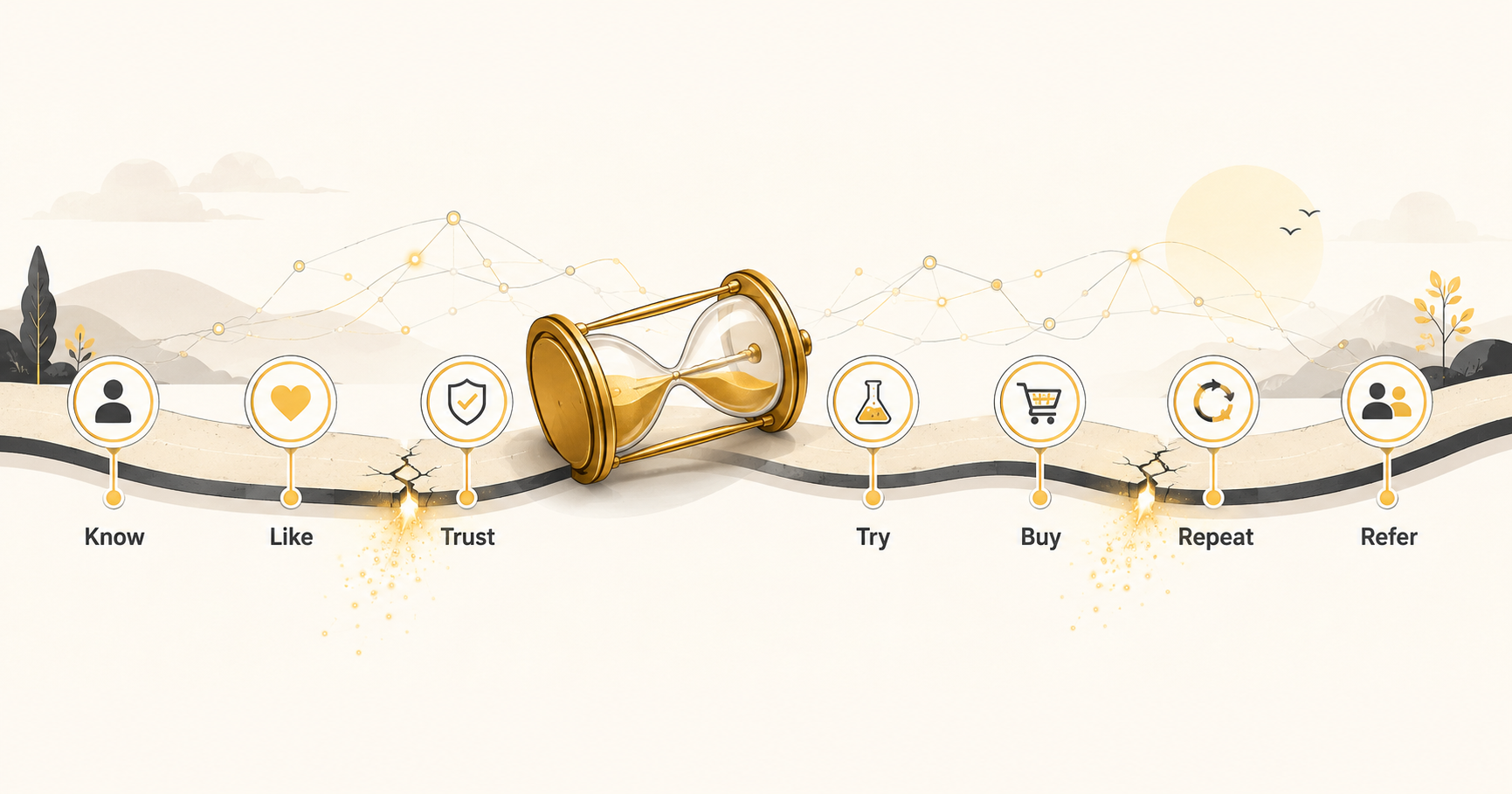
The path a buyer walks hasn’t changed. They find you, warm up to you, learn to trust you, take a small step, buy, come back, and send a friend. That part is human, and it isn’t going anywhere.
At Duct Tape Marketing we map that path with the Marketing Hourglass: Know, Like, Trust, Try, Buy, Repeat, Refer. A funnel pours people in the top and forgets them after the sale. The Hourglass widens again after the purchase, because repeat business and referrals are where the most profitable growth lives.
What AI changed is how buyers move through each stage. Walk through all seven with me and notice which ones feel thin in your business.
Know: how buyers find you
Buyers now run a full research phase inside AI before they ever reach your site. Someone asks “who helps a $5M HVAC company with marketing” and gets three names. “Best service near me” gets answered right in the AI summary while the map listings go unclicked.
And AI builds those answers from Reddit threads, directories, and reviews. Sources you don’t control. Forrester found twice as many buyers named AI their most useful research source than any other, ahead of websites, experts, and sales reps.
Whether you show up in the answer now matters more than where you rank.
What wins: pages that plainly state who you serve and what you do, structured so AI can read them. Presence on the sources AI pulls from. A mix of organic and paid.
On the paid side, we ran a small test of ChatGPT Ads for a client at $500 a month. Within a few weeks it landed an $18,000 client, larger than their average deal, with a shorter sales cycle. The buyer got educated inside AI before ever reaching out.
Like: how buyers warm up to you
AI made competent content free. So competent no longer stands out. Blog posts that could carry any company’s logo. LinkedIn posts written in the same AI cadence. Advice that repeats what every competitor is already saying.
The human voice is the one thing AI can’t copy. The founder on camera saying something a competitor wouldn’t. A story from inside your business that only you could tell. A public stance on where your industry gets it wrong. A voice people recognize in two lines.
The rule I gave the room: use AI to produce, never to think.
Trust: how buyers come to believe you
The web filled up with fakes, so buyers doubt everything by default. Reviews that all sound suspiciously alike. Testimonials with no name and no face. Stock-photo “teams” and AI-generated headshots.
When anything can be faked, real and verifiable wins. Your actual face and your actual team. Named clients a buyer can go check. A video testimonial from someone people can look up. Pricing and process shown in the open. Getting quoted or interviewed somewhere you don’t control.
Quick gut check: do you have a named, real proof asset you could point to right now?
Try: how buyers take the first step
Buyers want to try before they talk to anyone. They research and self-qualify long before they’ll book a call. Yet in most small businesses there’s no step between “interested” and “book a call.” A buyer who isn’t ready to talk has nowhere to go, so they leave.
That gap is a leak, and it’s the cheapest one to fix. AI made a real, low-risk first step cheap to build: a 2-minute diagnostic that hands back a personalized answer, a free teardown of their current setup, a calculator or scorecard they can run themselves, or a small paid engagement instead of a leap to a big commitment.
A buyer who takes your first step arrives more qualified and closes faster.
Buy: how buyers decide
Buyers show up already decided. They’ve read your pricing and your reviews. They’ve compared you to 2 or 3 competitors. They’ve fact-checked your claims against AI. The last question in their head is “why you, and can I trust you?”
Your job moved from convincing to confirming. Make the yes easy with clear pricing, a plain statement of who this is for, and one obvious next step. Answer the last doubt before it’s asked with a comparison, a guarantee, or a real result. And make sure what AI and reviews say about you backs up your own pitch.
Repeat: how customers come back
Anyone can generate Know, Like, and Trust content now. A delivered experience still has to be earned.
Here’s the good news for small teams. AI can personalize the relationship at a scale you never could by hand. Onboarding that adapts to exactly what the customer bought. Check-ins timed to how they actually use what they purchased, rather than a generic drip. Friendly reminders when it’s time to reorder or renew. Churn signals that catch an unhappy customer before they walk.
Refer: how customers send a friend
AI can prompt the ask, but the referral still runs on a person. Trigger the ask right after a win. Hand the customer a ready-to-forward intro. Give them something that makes them look good for sharing it. And sign the thank-you yourself.
One question worth sitting with: what happens in your business that’s worth talking about? Pick one moment.
Now score your own journey
Grade yourself 1 to 10 at each of the seven stages. Be honest.
When business owners do this exercise, a familiar picture shows up. A strong Know score sitting next to a Try score of 2. A journey that goes quiet after the first impression. A referral that never gets asked for.
Every one of those leaks traces back to the same place: no strategy holding the stages together.
AI is a multiplier. Point it at a real strategy and it pulls the right clients toward you faster. Point it at scattered tactics and it spends your money getting you lost quicker.
Strategy first, then AI
Strategy First is the layer that tells the AI where to aim. Who you serve. What makes you the obvious choice. The message and content that carry through all seven stages.
You have the diagnosis. Now get the plan. Book a Strategy First session and we’ll walk your journey together and find the strategy underneath it.
Recommended Story For You :

How To Make $3493 Commissions Without Doing Any Selling

Successful dropshippers have reliable suppliers.
People Think I Use A Professional Voiceover Artist. NO! I Just Use Speechelo!

Make Money Testing Apps On Your Phone Or Tablet

Make More Money or Lose Everything
Sqribble Is The ONLY eBook Creator You’ll Ever Need.

Work & Earn as an Online Assistant
Create Ongoing Income Streams Of $500 To $1000 Or More Per Day

It's The Internet's Easiest Side Business.